Friday, 31 January 2014

Starting of the story board

In this lesson we started to plan and draw out some possible storyboards for our title sequence, first we started drawing some ideas on some scrap paper, the first idea the group was able to come up with was filming the dress of a bride tracking forward down an isle as she is getting married the isle would then fade into a railway track so that it shows the bride walking across the tracks. This would be an interesting way of doing it but is quite complicated and time consuming, also however it did not quite hold the conventions of a rom-com as it was a little to serious, also we discussed this idea with other members of the class and they also said that maybe it did not follow the conventions.

The next idea we came up with for this lesson was filming the women or bride getting ready for her wedding day using a vanity table and all the makeup for all different kinds of shots for example close ups of her applying lipstick or mascara also there would be some basic shots of her doing her hair. The lipstick would be dark red which would help give suggestions and hints to the audience without us giving to much away, through the connotation of red which suggests sex appeal and love. The camera would then pan round towards the table showing the train tickets which gives the title sequence a train reference but not obvious. There will also be other shots such as a tie wrapped around the bed post, and pictures of happy couple placed faced down all suggesting she is having an affair with someone who she is not marrying there will also be a close up of her finger where there should be a an engagement ring where it will pan to the ring on the table.

The last idea we spoke about which was using a old camera, or a polaroid camera and taking pictures of the man and women and putting them in a scrap book or floating them onto a black background putting the titles below them. This seemed a little to basic and easy so we spoke about it and agreed that it was no the best idea to go with this one.

After discussing all three we decide to try and draw out our second idea and these are our first draft for the sequence and storyboard but not our final idea as not all the group were decided on it.


Wednesday, 29 January 2014

Codes and conventions of a Rom-com (romantic comedy)

There are codes and conventions for all types of genres for title sequences and you can see this through watching lots of different title sequences  it gives you an idea of the codes and convention which you should follow for each genre. Although it is smart to follow the codes and conventions you don't have to stick to every one of them as it may be difficult to include every single bit, because of the story of our film.


This is the code and convention for a Rom-com or romantic comedy:


Of these conventions we will only be using some of them and not all as we do not believe some will be beneficial to our piece of work.


Monday, 27 January 2014

Production Company

Production Logo/Company  

When creating out title sequence we realised we needed a production company of our own, for the title sequence we came up with lots of idea such as "xoxo productions", "Romline films" but there was only one that really stood out for us as we felt it matched the type and genre of the title sequence that we are creating, it is called Romway Films and from this we started to create logos for our chosen production company this was quite a long process as the group had a little trouble deciding on the 1st design we chose which was this:


The group together described it as simple and lets the audience know what the film or title sequence will be about, i disagreed and thought that it was a little to basic and had no colour, so from this I thought it was a little dull so I asked Laxmi who is currently doing Graphic Design as an A-level to create a new logo for our production company. A logo which would create a desired affect for the audience.

Saturday, 25 January 2014

Journal entry- 24/01/2014: The Changing Of The Genre

In this lesson me, Hayley and Laxmi decided to change the genre of our film from Romance to a Rom-com film we did this as we thought it would be easier to film a title sequence for a rom-com compared to filming a title sequence for a romance film. Also the film idea we have could be better suited to a rom-com as in our film the main characters are shown to be quite geeky so we could show a clumsy side of this in the title sequence.

Plot of our story now:
The film is called Train Affairs, the plot of this story is about a male and female city office workers, who encounter each over on the way to work on a bust train to Charing Cross Station. At this point they have not met or spoke but can see one another, and feel a strong attraction towards each over, which is portrayed through voice overs of both the man and the women's thoughts. After getting the same train for a few mornings they eventually end up seated next to each over where the male character finally plucks up some courage to ask our female character out on a date. When the female character says yes the male character does not show up for this date so the female is left feeling disappointed and angry that the man did not show up for their date however the twist in the plot is that the man actually had a tragic accident which meant he could not make their date and the accident left him with some memory loss, so the man was unable to remember the women. As the years past by the man started to regain parts of his memory and eventually remembers something massive, which happened to be the girl he fell in love with on the train. The man has a thought that maybe he could find this amazing women in the same place he met her years ago, so he takes the chance and ends up finding her on the same train, same carriage as she was all those years ago. He feels he needs to talk to her and apologise to her for not making the date. He goes over and she looks angry but also shocked to see the man, he explains what happens to which she forgives him and has some understanding and sympathy towards him. The problem is that the woman is now grown up and is getting married to another man, but their love for each over is still their so they arrange to meet and have a TRAIN AFFAIR.


Also in this lesson we created a big brainstorm of our film idea and title sequence to show all the things we will need and how we want the overall title sequence to pan out.


Friday, 24 January 2014

Karin Fong Group Presentation

This is our slideshare presentation on Karin Fong this explains all about Karin Fong and what she does within the title sequence industry and how she differs to other title sequence creators, she was our chosen person as she uses alot of animation within her title sequence i like this as it gives us a good understanding of the film before it even starts.


Thursday, 23 January 2014

Saul Bass's title sequence, Oceans 11-analysis

This title sequence starts by showing us the production company which is "Warner Bros. Pictures" which is probably one of the most biggest production company's even in the 1960's. This then turns into a black screen from where lots of yellow digital dots appear which then flashes and moves until it forms a big 1 which takes up most of the screen while this is happening the music being played is like a thinking/computing theme tune and then when the 1 is fully formed there is a sound which is celebratory, the digital dots on the screen then turn purple and start to takeover the 1 and turn into a 2 while the music is being played again, when it is formed it does the same noise and changes to a different colour which is blue. From this point the audience can tell that it is counting up to a number which is probably 11 if the audience know the title of the film.


However next to the number 3 is the first title of the sequence which happens to be the lead actor which is Frank Sinatra one of the most famous faces of them times as he was also an amazing singer. The digital dots continue to change colour and count up however when a title appears next to one of the numbers which is one of the actors a different sound is played after the number which represents that character, I believe this is done purposely by Saul Bass to try and give the audience a little hint about the characters in the film or maybe just about that person in real life.


The numbers continue to go all the way up with titles until it reaches number 11 where the title of the film kicks in as number 11 is in the title. Then some happy upbeat jazz music kicks in and the digital dots start to create different shapes against the black background in like a maze shape and in the middle of this maze some other cast members appear in a list, I think that maybe this could be another hint to the audience about the storyline. Then some interlinking circles are made up using the digital dots and in the holes there is some more cast members shown. After this there is some more maze type shapes made by the dots, this is where Saul Bass has put his own stamp on it with all the shapes giving the audience hints at the storyline of the film they are going to watch yet again.


This carry's on but starts to show other people other than the actors and cast such as the screenplay people, director of art and film editor and lots more. We are then shown two cards a king and a queen this tells me that the film could have some sort of trick in it and then a slot machine appears which gives us another hint that a casino could be in the film, so again lots more hints left by Saul Bass for the audience to see but is done very discretely.


Then we see another big shape made by the digital dots which then disappears and more dots come across the bottom to create a flat surface which a pair of dice role along which means that i then no for sure that a casino has something to do with it. Then finally on the dice after they are put back out with no dots on the directors name appears and they are then dragged off a table from which the film then fades in.


I enjoyed watching this title sequence I think it was well thought out and ran really smoothly, I believe the animation was simple but yet quite effective in the message hints it was trying to get across, so in my opinion it did the job that it was meant to and has lots of Saul Bass elements in which would let me know it was Saul Bass's work if I didn't already know it was his.           


Tuesday, 21 January 2014

Journal entry- 15/01/2014

Saul Bass

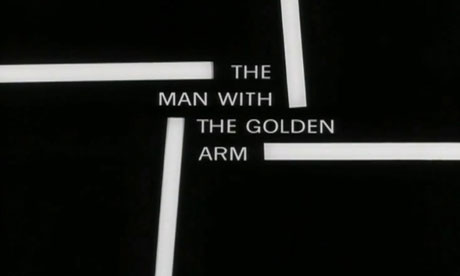
In today's lesson we looked at Saul Bass a legend within the title sequence and film communities most famous for works such as (The Man With The Golden Arm, 1955), (West Side Story, 1961), (Vertigo, 1958), (Anatomy of a Murder, 1959) and also many more.

He was born in the 1920's in the city of New York, Bass studied Graphic Design in his early life at the Art student league, Manhattan. Using his knowledge of Graphic Design Bass went into the job of creating film posters which eventually led him to start doing title sequences.
Bass was known for his use of simple, geometric shapes and how he used the shapes to symbolise things. His titles were often synopsis or actual reference to the movie he was creating the title for this was clever and not really done before in the title sequence industry. This gave the audience hints before the film what the film was going to be about this was done in a way that the audience would not always notice this.


Bass worked with some of Hollywood's greatest film makers such as Alfred Hitchcock, Stanley Kubrick and Martin Scorsese. Bass went on to make over 60 title sequences before dying at the age of 75 in April 1996. 


Karin Fong
After this we then got back into our groups and we chose a title sequence designer we wanted to research the title sequence designer we chose to do research on was Karin Fong we had to analyse two pieces of her work and also research some of her other work and about her life.